Military Gallery Tour stops in Rugby
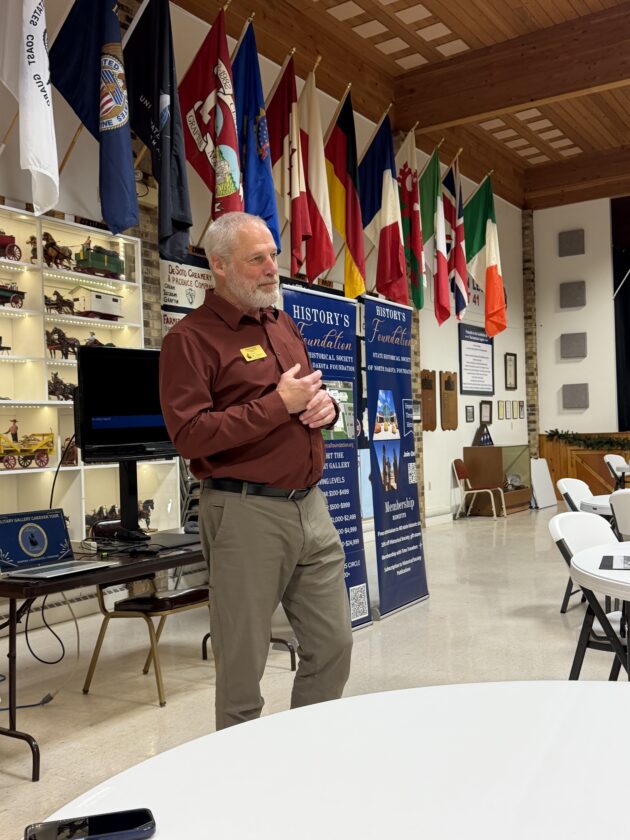
Submitted Photo Dale Lennon, executive director of the State Historical Society of North Dakota Foundation, gave a presentation in Grafton Tuesday, April 7, about the new Military Gallery being added to the North Dakota Heritage Center & State Museum in Bismarck.
Editor’s Note:
Dale Lennon, executive director of the State Historical Society of North Dakota Foundation in Bismarck, made a presentation in Rugby April 8 at the Memorial Hall about the Military Gallery being constructed at the North Dakota Heritage Center & State Museum in Bismarck. Lennon is making presentations about the Military Gallery during a tour of the state continuing through April 30. Lennon responded to questions following his stop in Rugby:
PCT: While sharing your presentation in Rugby (Pierce County) was there direction within your presentation that focused on members within the community?
DALE LENNON: Absolutely, and in Rugby that connection was especially meaningful for me personally. I graduated from Rugby High School, spent my early childhood in Wolford, and grew up in Knox. So this community has been a part of my life from the very beginning.
Having my sister and brother-in-law in attendance, along with Representative Jon Nelson, someone I’ve known all my life, made it even more special. There were many familiar faces in the audience and people I’ve known for years. That created a very strong personal connection throughout the presentation.
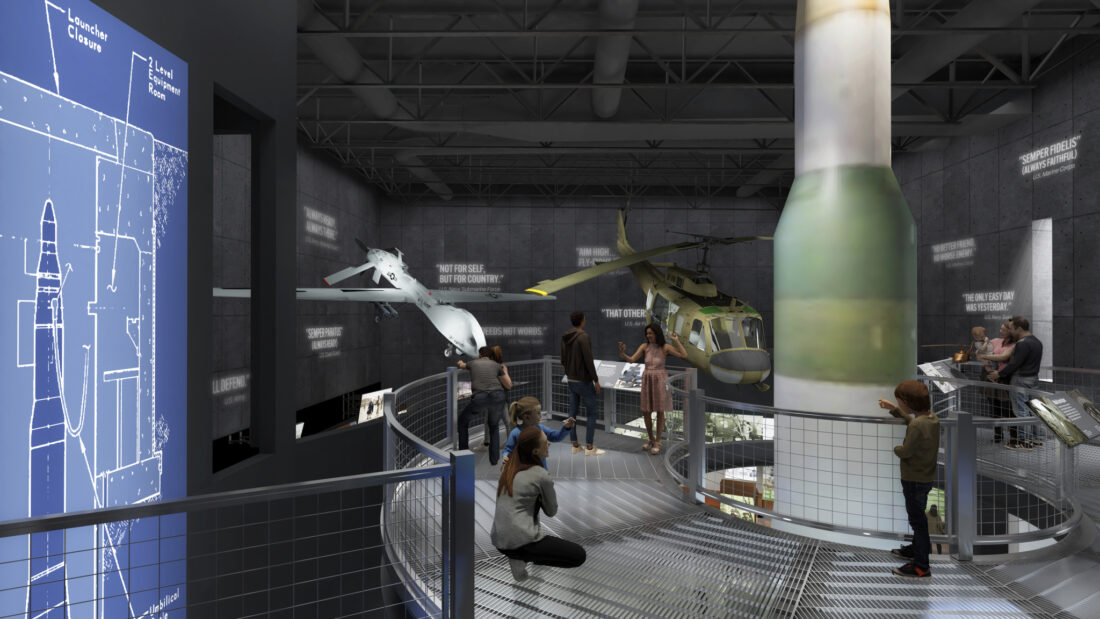
Submitted Photo The display of a decommissioned Minute III intercontinental ballistic missile will be in the new Military Gallery.
That’s exactly what this Caravan is about, connecting the Military Gallery to the people and communities whose stories will ultimately be told within it.
PCT: What are your thoughts on how weapons and tools of yesterday have changed so quickly today?
LENNON: The evolution of military tools and technology is remarkable. From the equipment used in World War I and World War II to today’s highly advanced systems, the pace of change has been significant.
What the Military Gallery will highlight is not just the equipment itself, but how those advancements have shaped the experiences of those who served. While technology continues to evolve, the constant remains the individuals and their courage, discipline and commitment to serving something greater than themselves.
PCT: Does N.D. or historical organizations notice differences in thinking between generations regarding military service and technology?
LENNON: One of the guiding principles of the Military Gallery is to Honor, Educate and Inspire all generations.
We recognize younger generations often view military service differently than previous ones. Current trends suggest if military service has been part of a family’s history, younger individuals are more likely to consider serving. However, if that connection is absent, the likelihood of considering military service drops significantly.
That’s where the mission of the gallery becomes so important. By honoring those who served and educating visitors about their experiences. We hope to inspire future generations to consider military service as a meaningful path.
PCT: What are your thoughts on AI, drones and advanced technology influencing military capability?
LENNON: North Dakota has taken a national leadership role in unmanned aerial systems (UAS) and drone technology. While much of the current application is not available for public discussion, it’s clear that drones are now a common and important part of national defense.
Within the Military Gallery, we will showcase that evolution. A Q1 Drone, one of the earliest drones used in military applications, will be on display, alongside references to more advanced systems such as the Q9.
Additionally, Cavalier Space Force Station plays a critical role in missile warning and space surveillance. Its presence in North Dakota highlights the state’s continued importance in national defense and technological advancement.
Another important part of North Dakota’s military story comes from the Cold War era. The missile silos spread across the state were a central part of the United States’ nuclear deterrent strategy. Hidden across wide rural areas, they provided a survivable second-strike capability, meaning the U.S. could respond even after an initial attack. Their dispersal made them difficult to eliminate in a single strike, strengthening national defense planning. In many ways, they served as a constant deterrent, helping prevent conflict by making a first strike far less attractive to an adversary.
We have secured a Minuteman III Nuclear Missile, and it will be one of the featured displays at the museum.
This history is an important reminder that North Dakota has long played a critical role in national security.
PCT: Who is a historical figure you reference who promoted peace and leadership?
LENNON: A figure I often reflect on is Theodore Roosevelt, who had a deep connection to North Dakota and whose leadership continues to influence our nation.
The biggest ways Roosevelt still shapes the United States today are in presidential power, conservation, regulation of big business, and America’s role in the world.
In my opinion, his biggest influence came in conservation. He protected about 230 million acres of public land and helped establish national forests, wildlife refuges, national parks and monuments. That is a foundation of the modern conservation movement.
His leadership philosophy is captured well in probably his most famous quote, “It is not the critic who counts; not the man who points out how the strong man stumbles or where the doer of deeds could have done them better. The credit belongs to the man who is actually in the arena.”
PCT: Is there anything you would like to share with the general public, service members and veterans in Rugby?
LENNON: The Military Gallery is being created to represent all branches of service, along with the many women who have played vital roles in supporting our military efforts throughout history.
It will also highlight aspects of service that many people may not realize, for example, North Dakota even has a Coast Guard presence, and that story will be included as part of the gallery’s broader narrative.
To the people of Rugby and Pierce County, I would simply say thank you. Your stories, your service and your support are what will bring this gallery to life. This is truly a statewide effort, and it’s an honor to help ensure that your contributions are recognized, preserved and shared for generations to come.
- Submitted Photo Dale Lennon, executive director of the State Historical Society of North Dakota Foundation, gave a presentation in Grafton Tuesday, April 7, about the new Military Gallery being added to the North Dakota Heritage Center & State Museum in Bismarck.
- Submitted Photo The display of a decommissioned Minute III intercontinental ballistic missile will be in the new Military Gallery.
Local News
Retired doctor hikes across France to Spain
State hears perspectives on proposed hog farm