Gym floor repairs addressed
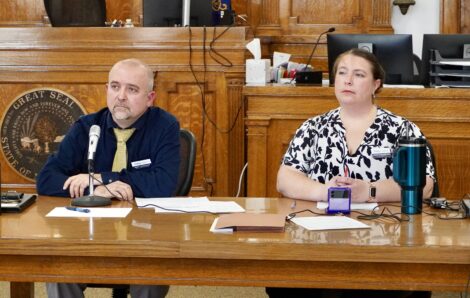
Aside from a damaged gym floor, school doors are ready to open, administrators told the Rugby School Board at its regular meeting Aug. 12. The board heard final reports from administrators before the kickoff of the new school year on Wednesday, Aug. 20.
Secondary Principal Jared Blikre reported everything appears to be in place for the start of school, apart from addressing water damage to the gym floor after water leaked through the roof. Blikre said the junior high class sizes are up a little bit from last year, with 110 between seventh and eighth grades. He said the high school was fully staffed with the new hire of a special education teacher.
“Just excited to get the kids back in the building and back into a routine,” Blikre said.
Regarding the gym floor, Superintendent Mike McNeff said the issue arose July 20 when a storm dumped 2 inches of rain in a short period of time, which caused a significant amount of water to flood the southeast corner of the gym and spread into the cafeteria and band room.
“I contacted the roofing company right away, and they went up on the roof and found they didn’t install a membrane around the edge appropriately, so they admitted fault to that,” McNeff said.
McNeff said work immediately began to shop-vac water and get fans going before Clean Tech could get to work that afternoon. McNeff said 600 gallons of water were removed from under the gym floor, and dehumidifiers were running constantly from July 21 until Aug. 11.
McNeff said discussions were ongoing with the owner of D and D Roofing, who he said had done good work replacing two other sections of the roof, but the company was following up with its insurance company. McNeff said a wood floor installer, who was asked to inspect the damage, indicated the floor was likely to crack when things dry out in the winter. Additionally, there are some concerns about the tartan subfloor deteriorating, as McNeff said the cost of demoing and replacing could be “astronomical” if it is found to contain mercury.
McNeff said the district’s insurance company denied the district’s claim because the flooding was the fault of the contractor. McNeff shared that the decision was made to give up on drying out the floor, as replacing the floor is the only viable option. McNeff said the cost of running the drying equipment was $34,000 over the last few weeks.
“There’s still considerable water under the floor, so we’re looking at considerable mold issues. We’re never going to dry it out. So we quit doing that,” McNeff said. “We’re going to have to fight with the adjuster over who has to pay for that. Of course, we shouldn’t, so we’ll see where that goes.”
McNeff said the quote for replacing the gym floor was $260,000, and other costs were identified for the replacement of some electrical equipment. McNeff said the armory and the Ely Gym could be used for volleyball and other uses until the floor is replaced.
The gym floor was installed in 2001, and conversations with the adjuster indicated the district would still be on the hook for about 30% of the replacement cost, or about $75,000-100,000 in unplanned expenses.
McNeff suggested continuing to use the damaged gym for practice, but if decisions are made quickly, the new floor could be ready in six to eight weeks. McNeff also suggested replacing the current bleacher system because it would cause problems for replacing the gym floor underneath it. The cost of the new bleacher system was quoted at around $250,000.
School Board President Dustin Hager said until the full cost and other factors are determined it would be hard to make a decision.
“It seems to me that if they think moisture is still under there, my question would be – what happens to the moisture when the floor comes out? How do we ensure everything’s dried out when we put the new floor on top?” Hager said.
McNeff indicated the tartan floor was being tested for mercury. It is about an inch thick, and he wasn’t sure how much moisture it could absorb.
McNeff said he would provide the final options for the board to make a decision as soon as possible.
“When we talk about the importance of an ending fund balance, it’s for issues like this, right? Because we didn’t plan for this,” McNeff said.
McNeff also reported on updates to changes to Title funding, which he anticipates will be delivered through block grants to the state.
“The problem that we think will happen is that there are a lot of rules that are going to have to get changed, and they very likely aren’t going to touch reauthorization of elementary and secondary education anytime soon. The Title I regulations are very strict, and we’re going to have to follow Title I regulations for the rest of these funds,” McNeff said. “It’s a lot of oversight and red tape. So we’re worried about that. We do think federal funds will continue to dwindle. That’s kind of what our group’s been told. We met with Senator Hoeven a couple weeks ago. We’ll have to see what happens.”
Business manager Dawn Hauck provided an update on the audit for the 2024-2025 school year, which she described as “brutal,” but indicated everything seemed good so far. McNeff said the audit was more involved due to the amount of federal funds the school received last year.
Hauck identified a $125,000 difference from 2024 to 2025 at the end of July, which she attributed to the absence of certain grant funds. Hauck said there was $23,000 in meal debt, but the majority was with families who are likely to pay at registration.
During a review of financial reports filed by the district with the state and the Department of Education, Hager asked for an explanation for the differences in average cost per pupil between the elementary, junior high and high school students. Grades 1-6 cost $13,644.23 per student, Grades 7-8 cost $11,433.83 and high school students, on average, cost $15,221.67.
McNeff responded it could be due to electives or career technical education opportunities available to high school students beginning with freshman year. Hauck clarified that, technically, the junior high should be factored into the high school average, but they are split up when the data is broken down. McNeff said the districtwide average of $13,781.27 is the most important number, and it is in line with other districts of RPS’s size.
“What they’re trying to get at here on the federal side of things (is) are you spending more at this elementary school versus another elementary school. So, in the larger districts, they want to make sure those Title funds are distributed equitably to all. We’re just one school,” McNeff said.
The board approved both financial reports.
Local News

Retired doctor hikes across France to Spain
State hears perspectives on proposed hog farm