Brossarts one of many area families with ties to Ukraine
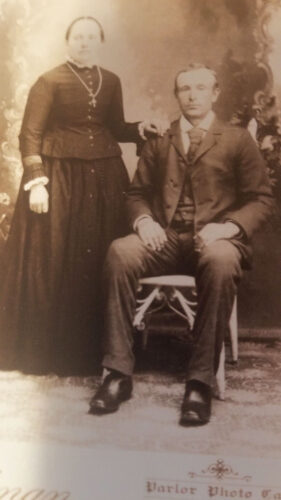
Submitted Photo Johannes and Franciska Brossart pose for their wedding photo, taken in South Russia in 1885.
The sweet smell of a recent rainfall filled the air as Ron Brossart looked out over the flat, grassy land. Although there were no headstones in sight — they had been destroyed years ago, crushed and used for building roads — he was looking at a centuries-old cemetery.
The cemetery was not far from Odessa, Ukraine, the area where Brossart’s ancestors lived before immigrating to the United States.
“Looking out over that cemetery, knowing my ancestors were buried there … it was an eerie feeling,” Ron said.
Ron and his father, Valentine, traveled to Ukraine in 2005 on a Journey to the Homeland Tour through North Dakota State University. Led by Michael M. Miller, NDSU has been offering ancestral heritage tours to Ukraine since 1996.
Michael is director of the Germans from Russia Heritage Collection at the North Dakota State University Libraries in Fargo.
“Watching the sad developments of Ukraine, I am deeply concerned about the many friends and colleagues we met through the Journey to the Homeland Tours in the former Black Sea and Bessarabian German villages in Odessa,” Michael said. “Ukraine is the homeland of many German-Russian ancestors in Pierce County and in North Dakota.”
Looking for a
better life
In 1804, the Brossarts’ ancestors left what was Germany at that time to live in Ukraine at the invitation of Russia’s czar. The Brossarts settled in the village of Selz. They were some of thousands of Germans that migrated to Ukraine, living there for about 100 years to take advantage of free land, religious freedom, and other rights and privileges promised to them.
In 1871, Russia’s czar revoked the rights and privileges given to the German settlers. The settlers were dismayed and angry and began to emigrate out of the country.
In 1889, Johannes “John” Brossart, Ron’s great-grandfather, came to the U.S. from Ukraine. John, his wife, Franciska, and their son, John, took the train as far west as it went to Eureka, South Dakota. John left Franciska and his son with a relative near Eureka and traveled north, finding land near Hague, North Dakota.
John built a 14-by-16-foot sod hut and moved his family there in July 1890. John and Franciska welcomed a daughter in late 1890 and another son in 1892. A fourth child (Ron’s eventual grandfather), Frank, was born in 1893.
The family spent two or three more years near Hague – and added three more children to their brood – but they weren’t making a good living. The soil in Emmons County wasn’t productive. They moved north to Blumenfield in McHenry County, where they had two more children, and 10 years later moved again, settling northeast of Berwick.
Both of Valentine’s parents had Ukrainian roots. His mother, Elizabeth Voeller Brossart, was born in Ukraine. She came to the United States around 1910 at the age of 17 or 18. Ron recalls her sharing stories about her childhood.
“She had pleasant memories of her life in Ukraine until the last couple years,” Ron said. “They were doing well, farming some of the most productive land in the world. Then Russia started changing the rules.”
Journey to the homeland
Ron said his dad was fascinated by his mother’s stories. When Valentine heard about NDSU’s tours in the early 2000s, he told his family he wanted to go. When no one else expressed interest, he brought it up again. He wanted to go, and he wanted someone to come with him.
“At the time I wasn’t really interested in it, but in a moment of weakness I agreed to it,” Ron said.
On their Ukrainian tour, Valentine and Ron visited the villages where their ancestors lived. They spent several days in Odessa, a day in France, and a few days in Germany. They saw a building in Ukraine that was in the beginning stages of becoming a museum about the Germans who migrated to the area.
“Have you ever done something in the moment that you didn’t really think about, but it turned out to be the best thing? That trip is one of the things in my life I’m sure glad I did,” Ron said.
Not long after their trip, Valentine’s health started to decline. He passed away Jan. 3, 2008.
Leaving a legacy
Ron later learned that his dad made a financial contribution to the Ukrainian museum they saw on their trip. He also learned there are photos of him and his dad — taken during their 2005 trip — hanging in the Ukrainian museum.
“Who knows if that museum will be around much longer,” Ron said. “Only God knows what’s going to happen in Ukraine now.”
Valentine’s heritage was of great importance to him, and he supported not only the Ukrainian museum but also a new building on the grounds of the Prairie Village Museum in Rugby. It was his dream that a new building be created at the museum to honor those who settled this area, allowing their descendants to have a better life.
The new building, which opened in October 2021, was made possible by the Brossart family’s generosity, along with the support of many other donors and volunteers.
A display in the new Germans from Russia building offers a detailed look at individual families that settled in the area. Visitors can learn about the people who came from Russia, including details about their original German homes, the area of Russia they came from, and information about their trips to America, such as ship names and ports of arrival.
The Prairie Village Museum opens Sunday, May 1, for the 2022 season.
As for future NDSU tours, they are postponed indefinitely because of the recent invasion of Ukraine, according to the NDSU website. The website states, “We do not know what the future holds for Ukraine – but we hope one day we will be able to visit our friends again.”
Excerpts printed with permission from the Germans from Russia Heritage Collection, NDSU Libraries, Fargo, ND. https://library.ndsu.edu/grhc
Andrea Blessum is the daughter of Jerry and Kathy Blessum of Rugby. She graduated from Rugby High School and the University of Mary. Blessum is a descendant of John Brossart and his family, Germans who lived in the Black Sea region of Ukraine in the 19th Century. Blessum lives in Bismarck, where she works in public relations for MDU Resources.
Local News
Former Rugby resident takes Honor Flight
Retired doctor hikes across France to Spain