HAMC studies options for new hospital
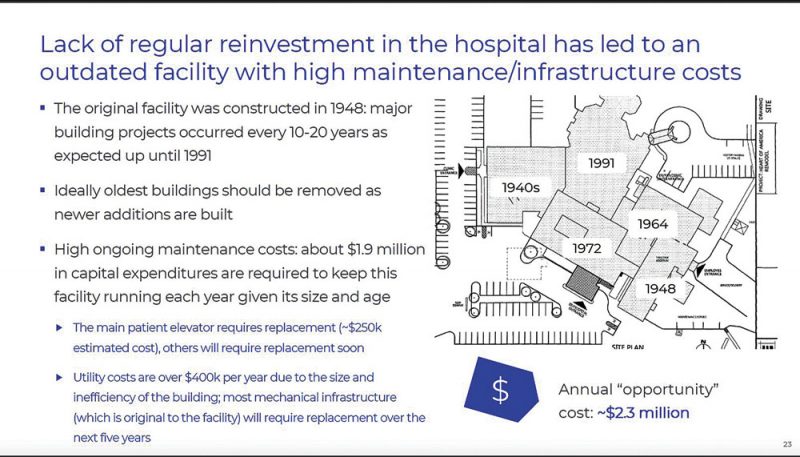
Submitted Photo A page from a study done by accounting firm Wipfli shows a site plan from Heart of America Medical Clinic with several additions.
Upkeep costs for aging hospital infrastructure and missed opportunities for Medicare reimbursements make a strong case for a new Heart of America Medical Center, according to information provided by CEO Erik Christenson.
Christenson said a steering committee would meet April 7 to “suggest the next course of action” for the hospital.
Seven members of the Rugby area community, three members of the hospital board of directors and three board-appointed employees will make up the steering committee.
Christenson said the idea of a new hospital began “with the strategic plan we did last summer. The community came back with the idea that we needed to look at a new building possibility.”
The board hired accounting and consulting firm Wipfli of Milwaukee, Wisconsin, to determine the feasibility of a new hospital and study other possible options. Christenson said the firm developed a master plan for HAMC.
“Normally, hospitals every 10 to 15 years do a major remodel or rebuild. We’re way behind,” Christenson said.
“Basically, we have a hospital design from the 1970s, based on long inpatient stays, non-ambulatory care and we’re way oversized,” Christenson added.
“We have 150,000 square feet and they say, really for what we provide, it should be closer to 70,000,” Christenson noted. “And they also say we should separate our care center from the hospital. It’s really affecting our cost report. Having it on the second floor affects how we get paid from Medicare to a great extent. It’s a huge, huge negative.”
“In a critical access hospital, you’re based on the utilization of your square feet,” Christenson explained. “With the care center on the second and third floor, we have to spread a lot of our costs over those square footages and we’re not getting paid for it.”
“We’re not getting paid for the administrative time, the HR time, the various other times that get cost counted up there,” he added.
Christenson said Wipfli’s analysis recommended moving the facility’s care center, currently on the second and third floor of the hospital building, to another location.
“They used terms anywhere from $1.8 to $2 million per year in opportunity costs lost by this organization,” Christenson said of the missed opportunities for capturing Medicare reimbursements caused by the center’s current location and layout.
“So, it’s a significant issue,” Christenson added. “It’s pretty clear from Wipfli who has done this for many different organizations, that if something isn’t done, there will be some major consequences down the road for this health system to the point that it may become very difficult to maintain operations.”
Christenson said the hospital’s present rambling design, composed of a main structure dating from the 1940s with additions in 1964, 1973 and 1991, creates wasted space and results in staff inefficiency.
“Today, we had another cooling unit go out and we have to figure out how to fix it,” Christenson said, adding, “the boiler system is ancient. All our mechanical equipment is in the (1948) portion of the building. Part of it’s in the ’64 part but it’s in the older portions of the buildings that mechanical equipment’s in.”
The hospital’s foundation is currently raising funds needed to replace its inoperable elevator.
“So, it’s a huge struggle to try to update all this and the expenses become arduous,” Christenson said. “You struggle reinvesting into your organization because you spend all your extra money just for upkeep and maintenance. Like $250,000 for the elevator.”
Christenson said the suggestion for a new hospital was one of three options Wipfli presented.
“You could do nothing,” Christenson said of one option. “And they’re basically saying, ‘not a good idea,’ you should be reinvesting into something.”
“You could remodel onsite,” Christenson said of a second option Wipfli looked at. “The problem with that is, the cost is about the same as a brand new facility and phasing is really difficult, meaning you’d have to tear down the clinic or other parts and figure out where you’d provide those services while you’re rebuilding.”
“Plus,” Christenson added, “there’s an ominous warning with Wipfli that their experience has been that with remodels and the phasing process there’s been extreme inflation of the cost of construction lately.”
“For example, you could have a $40 million remodel project that could turn into a $60 million dollar project,” Christenson said.
“Then, the third option is to build new,” Christenson added. “And Wipfli is basically saying if they were to look at it, that’s what we should do as a facility.”
“They did the master facility plan and the initial affordability (analysis) indicated we could afford to do so,” he noted.
Christenson added, “Given the money we could save based on efficiencies, decreasing maintenance costs, increasing Medicare cost report reimbursement – all of those put into the plan would make it affordable for us to pay off the debt.”
“Plus,” he noted, “we’re sort of in a sweet spot for loans, interest rates are low, however, we’re seeing inflation in the cost of buildings. So, all that goes into their concept.”
Christenson said the master plan and recommendations are the first of a five-phase plan by Wipfli.
The second phase would signal a greater commitment to building a new facility due to “significant costs,” Christenson said.
The expenditures would amount to “anywhere from $90,000 to $100,000 and that involves an initial application for funding to the USDA and detailed feasibility analysis to secure what you can’t afford,” he said.
“We’re probably not going to build on the same site,” Christenson said of plans for the new building. “To (demolish) a building takes probably $15 per square foot and you figure 150,000 square feet is about $2.25 million, so two to four million dollars to (demolish) the building. We would probably move next to Highway 2, somewhere different.”
Christenson said the hospital would ask the City of Rugby for ideas for using its former facility.
The newer, more efficient facility proposed for HAMC would cost approximately $40 million, Christenson said.
“We can get USDA funding for the clinic and hospital; with the care center, we wouldn’t be able to afford all that,” Christenson explained. “So, the idea of looking at a new care center might involve a possible remodel of Haaland Estates and putting a care center there. But that might require a capital campaign by the community to help us with funding and get that set up. So, we might get two simultaneous operations going.”
“With the association itself, if we separate out the care center from the hospital, we could afford up to $45 million (for a new hospital),” Christenson noted, adding the hospital could fund the debt through loans from the USDA, Bank of North Dakota and other sources.
“But the association itself, based on our operations, should be able to build the hospital and would not require funding.”
Christenson said the new facility would help HAMC stay open. It would not mean cost increases for patients.
“Cost of care isn’t affected by new buildings,” he said.
“A new hospital with the new reimbursement structure, efficiencies, decreased costs of utilizations of that facility and more efficient use of staff in providing care – it creates a sustainable association for health care services in this community in the long term. This becomes a 20 to 30 year plan. We assure health care for 30 years down the road.”
Christenson said HAMC is seeking input from the community it serves.
“We’re looking to have conversation, communication and try to explain why we’re looking at this new building; why would we be doing this and just try to explain to everybody our thinking behind everything,” Christenson said.
“Hopefully (learning about the plan) helps to educate and move us forward and gain confidence that it can be done. If that’s the case, it will get everybody on board and excited for this project,” Christenson said.
“As far as I’m aware, a project like this would be the largest economic project in the history of Rugby,” he added.
Local News
Former Rugby resident takes Honor Flight

Retired doctor hikes across France to Spain