First Street residents voice concerns at hearing for elevator propane tank
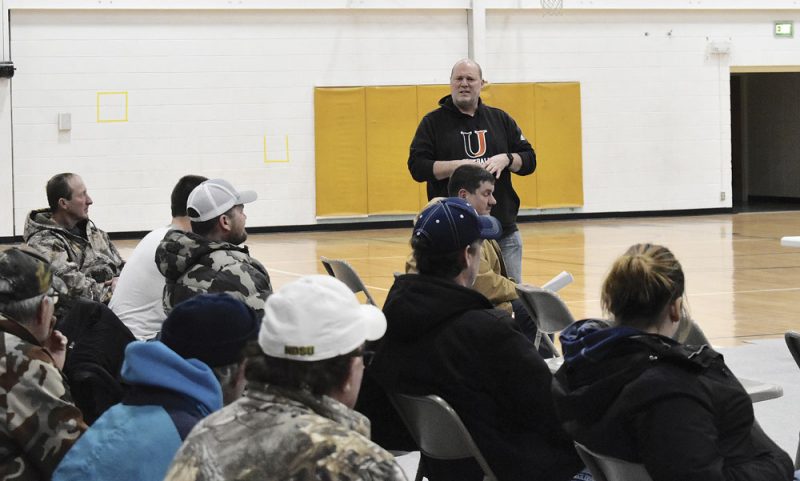
Sue Sitter/PCT Rugby Farmers Union Elevator Manager David Holzwarth, standing, answers a question by a First Street resident at a special city council hearing March 1.
Concerned residents of First Street in Rugby voiced their concerns over a proposal to locate a 30,000- gallon propane tank in their neighborhood. The hearing was held March 1 at the Rugby Armory.
Wearing a T-shirt that read, “First St. Lives Matter,” resident Karen Larson asked questions along with her neighbors about the safety of the tank at a special hearing, where city council members voted to decide on a variance request by the elevator.
Larson said she had read online how propane explosions make it possible for objects to melt from their heat 1000 feet away.
“Google it,” Larson said. “It says if you’re 1,000 feet away from that, you could burn.”
Another concerned citizen said his daughter, son-in-law and grandchildren live near the elevator and its four 1,000-gallon propane tanks. “I farm with these guys and know these guys. I know what they’re trying to do,” he said.
“But this has nothing to do with money or efficiency. The one question we have to ask is what if? That’s the only question that matters.”
Pointing to a wall in the armory about 100 feet away, Koenig said his daughter’s family lives “as far away from that elevator as we are from that wall,”
Koenig referenced propane tank explosions in North Dakota cities such as Gwinner and Minot.
“In Gwinner, North Dakota, they had a huge tank sitting on their lot,” he said. “The tank failed. Someone said something about ends coming out – that’s what happened. It created a huge vacuum that sucked doors and windows in on the building.”
Another resident who declined to be identified recalled fighting a fire in Lakota, where a propane tank ignited at a connection, creating a blaze that forced firefighters to ask Air Force personnel from Grand Forks for help.
However, the resident later changed his mind when he heard an explanation by elevator manager David Holzwarth about the risks posed by connecting several tanks compared with maintaining a single tank.
“One 30,000-gallon bullet is safer than 20 tanks out there, each with their own regulator, and all the plumbing to go along with that,” Holzwarth said. “So, we just risk more safety measures if we continue to have more tanks out there.”
Holzwarth said the elevator sought a variance for a single larger tank because of the constant need for refills on the smaller tanks, each refill carrying its own risk.
The refills were needed to meet demands for grain drying.
“A couple of years ago, we were on allocation. We could only dry so much (grain), then shut down, then dry it again, and it just dragged out forever. We’re dealing with two-year corn today that is still stuck in our bin because of that,” Holzwarth said.
As council members listened to the discussion, some added their own input. Member Gary Kraft said the board had researched the effects the tank would have on FHA loans and homeowners insurance.
City Attorney Bill Hartl said residences within 300 feet of a propane tank in excess of 1,000 gallons would not likely receive FHA loan assistance.
The elevator currently has a bank of four 1,000-gallon tanks, which would already disqualify any property within the radius from receiving the financing.
Holzwarth noted the elevator would add safety features to the tank such as security fencing. He also said the elevator planned to partially bury the tank, which might cut any risks in the event of an explosion.
Some residents asked why they had received letters informing them of the hearing.
Mayor Sue Steinke told the residents they had received the letters “because the elevator applied for a conditional use permit from the city and the residents in the city within a certain area have the right to protest the conditional use permit.”
Council member Joel Berg asked, “If you don’t put a 30,000-gallon tank in and you put 20 1,000-gallon tanks in, you don’t need anyone’s permission, do you?”
“No,” Holzwarth answered.
“Why can’t you keep a 5,000-gallon tank, put the 30,000-gallon tank out of town and truck it in?” Koenig asked. “You don’t have to set up 15 or 20 1,000-gallon tanks,” he added.
Elevator representatives maintained the increase in refills would pose a greater risk than keeping the 30,000-gallon tank at the elevator.
“We’d love natural gas,” elevator board member David Kraft said. “If natural gas came in, we wouldn’t need a tank. And if you can get it here, we’ll take it. So would a lot of other people. That would be a stop to all of this. So this is where we’re at.”
Council member Jackie Albrecht, who represents the neighborhood near the elevator said, “I think in retrospect that the elevator and city made a bad decision when they expanded but it’s here, they did it; it’s not going to go away.”
“I feel these guys, by communicating with everybody, they’re trying to make it as safe as they can,” Albrecht added. “From my perspective, that large tank is going to be safer than all the smaller ones.”
Council member Frank LaRocque, who shared his experiences in hazardous materials training as a Highway Patrol officer, said he believed the single 30,000-gallon tank would be safer as well.
Local News

Former Rugby resident takes Honor Flight

Retired doctor hikes across France to Spain