HAMC town hall meeting explores future of community health care
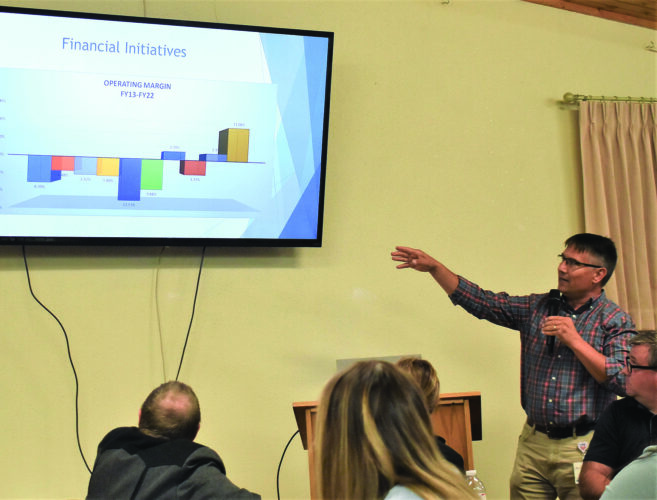
Sue Sitter/PCT Heart of America Medical Center CEO Erik Christenson shows attendees at a town hall meeting a graph tracking the hospital’s finances.
Residents filled the Rugby Eagles dining area to capacity Monday, Aug. 21 for a town hall meeting to discuss health care and the effects the new hospital will have on the community.
Heart of America Medical Center (HAMC) CEO Erik Christenson showed a slide presentation about the hospital before taking questions.
Christenson sought input from members of the public, hospital board members, hospital administration, and medical staff in the audience. He detailed improvements in leadership, human resources and board functions.
The discussion then moved to the financial aspects of the hospital.
“We’ve had three years in a row with positive bottom lines,” said Christenson. “I’ve been with the organization since 2000, and that’s the first time we’ve ever done that. We are having issues with contract labor, but we should be able to be positive by the end of this fiscal year as well.”
He said the hospital showed $7.9 million in net assets when he became CEO.
“That figure has grown to $40 million today. It will keep going north as long as that building gets added to the organization. Heart of America Medical Center will be an $80 million organization after the next couple of years. It’s a really good sign for the community as far as sustainability,” said Christenson.
A committee had studied ways to preserve the hospital’s current structure, most of which had been built in the late 1940s and 1970s. The costs of keeping those portions from deteriorating and risking local ordinance violations made saving the structure nearly impossible. Staff had proposed saving the newest wing, built in the early 1990s by converting it into a hospice care facility.
Other developments include creating a board and tax district for the ambulance service to meet requirements of North Dakota House Bill 1365, which gives the responsibility of operating the services over to local governments and creates governing boards appointed by county commissioners.
Costs for ambulance services are funded by millage tax rates.
“Once that board is formed, we’re looking at building an ambulance garage on the new site,” said Christenson.
The new structure includes 18 long-term care beds and seven acute care beds.
The staff had voiced concerns about updating the Haaland Estates elder care facility to help residents stay in their community. As Rugby’s population ages, the number of patients with dementia will also increase, creating a larger need for memory care in the community.
The Haaland Estates building, built in 1962, needs new roofing, updates to its bathrooms and other renovations.
Christenson and staff members have developed an initiative to meet the challenges by forming a board for Haaland Estates that is separate from the hospital board. To pay for needed improvements, Christenson proposed establishing an endowment fund through Inspiritus Community Health Foundation, a North Dakota nonprofit.
“Rugby is really paving the way for a small rural hospital,” said Christenson.
Local News
Rugby works to overcome employment challenges
Pumpkin patch features painted straw bales